septembre 04, 2026
New school year, new planetarium show lineup
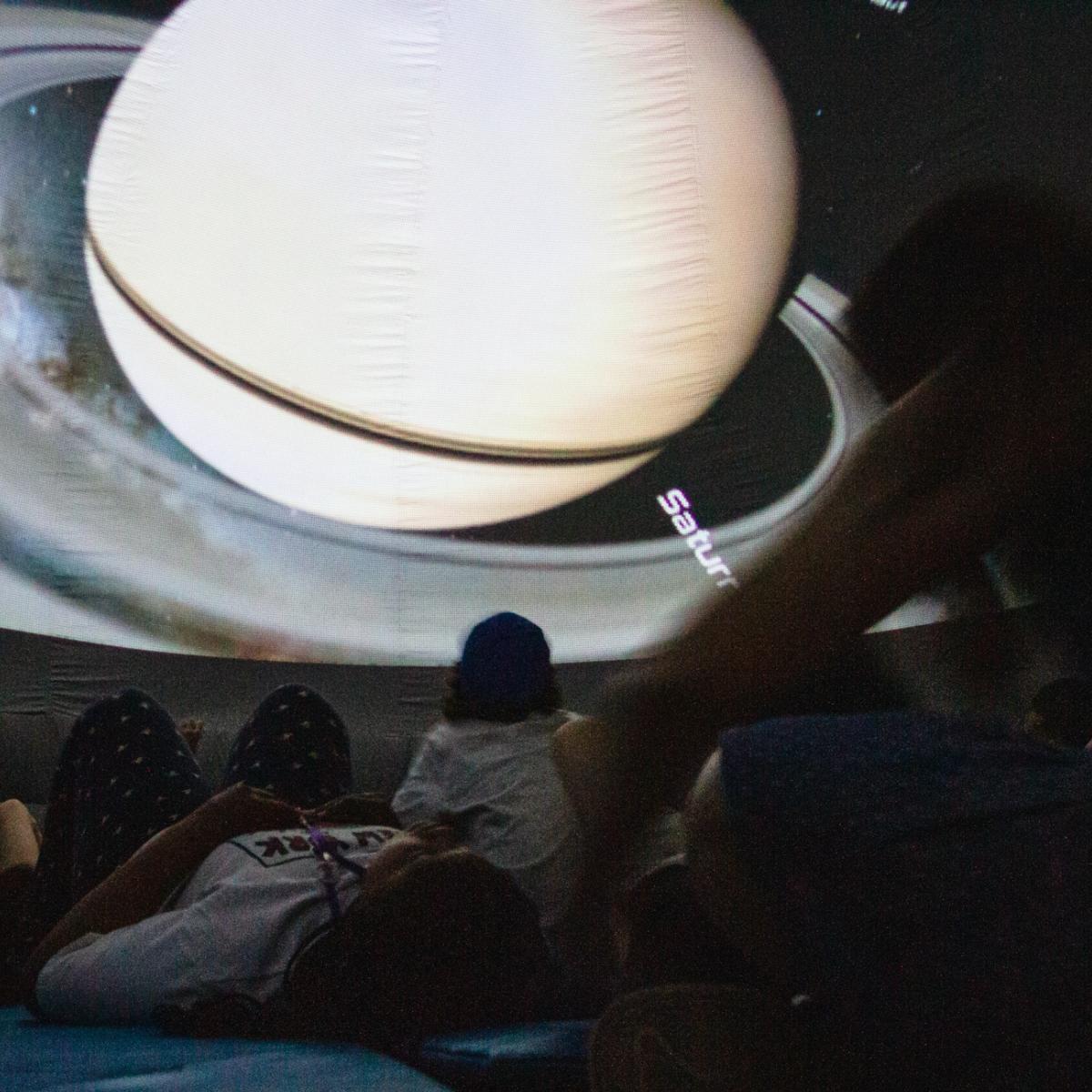
Making room for the topics I want to cover
Over the summer, I re-thought, re-wrote, and re-rehearsed my planetarium shows for the 2026-2027 school year.
Since early 2024, I gave essentially the same 25-minute show to almost every grade level, adapting to the age of the students.
That's not a bad thing! The kids loved it. But it felt kinda superficial. And especially with older students, I wanted to get deeper into really cool topics.
That's what this summer re-architecting has done. It's designed around each step change in the Québec curriculum, and I want to give you a short rundown of what each show teaches.
Interested in a dome at your school? Book now.
Welcome to the Sky
- Preschool and Elementary Cycle One (Kindergarten, Grade 1 & 2)
- 25-minutes long
- Learn more
A nice intro to the sky for young kids. They learn about the stars and how humans can imagine shapes they make (mostly animals). Then we rocket up into space and see Earth from above. I move time forwards to show how the rotation of Earth causes day and night.
In my previous show, I packed too much in 25 minutes. For kids this age, getting just 1 or 2 concepts into their brain is the goal.
Earth, Moon, and the Solar System
- Elementary Cycle Two (Grade 3 & 4)
- 35-minutes long
- Learn more
Expanding on the previous show, we venture out beyond Earth. We visit the Moon and understand why it has phases. Then we do a brief tour of the planets in the Solar System.
In the old show, I only had time to show Mars, Jupiter, and Saturn. I'll see how this new format goes, but I think I'll be able to show more planets to the kids with 10 extra minutes.
Exploring the Milky Way
- Elementary Cycle Three (Grade 5 & 6)
- 45-minutes long
- Learn more
One of the complaints I got from students was that shows were too short. I agree! I felt stressed only having 25 minutes to cover everything. Now, with 45-minute shows, we can slow down and delve into more fun space stuff.
In this show, we can go deeper into learning about constellations. What is the actual shape of a constellation? We can learn more about the Moon, its phases, and tour the planets in the Solar System. Then we zoom out and get an impressive sense of how big our galaxy and the universe is.
Space Phenomena
- Secondary Cycle One (Grade 7 & 8)
- 45-minutes long
- Learn more
Now we can get technical. In this show, students will learn what causes meteor showers, aurora borealis, eclipses, and more. This would be too advanced for younger grades, but I've been itching to do this type of show for years.
Life Around Other Stars
- Secondary Cycle Two (Grade 9 & 10+)
- 45-minutes long
- Learn more
Now we can get super technical (and still have fun). My fiancée works at iREx, an institute at the Université de Montréal that helps with the search for planets beyond our Solar System. In this show, we're going to learn how many exoplanets we have found, how we found them, and then actually go to them and see what (we think) they look like.
This sounds super technical, and it is, but I'm excited to get philosophical in this show. The galaxy is packed with exoplanets. Completely stuffed! And I want students to walk away, look up at the night sky, and know that they are facing towards thousands of other planets out there.
Not only that, but also showing that people in our city, Montréal, are contributing to this incredible knowledge.
Updates over the year
Some things will work, and some things won't. I'll be learning along the way for the first few months and will post here with my findings of what sticks.
But overall, really excited to start doing the shows that I've been dreaming to do since starting the planetarium in early 2024.
You can book a planetarium show here. Thanks!